For a business that has invested in rooftop solar, the cleaning question usually arrives in the form of a quote and a claim. Dirty panels, the pitch goes, are quietly costing you a large share of your output. Some suppliers say as much as 30%. Others quote figures as wide as 15% to 70%. A South African field study found losses that were a small fraction of that. The honest answer to how often solar panels should be cleaned in South Africa depends on your site, and the people best placed to give it are the ones who look at your actual output data, not a calendar.
What is not in dispute is the roof. Every cleaning visit puts people at height on a surface that was never designed to be walked on. In South Africa, the Occupational Health and Safety Act 85 of 1993 requires employers to provide a working environment that is safe and without risk to health, and that duty does not stop at the roof edge. For work at height that falls under the Construction Regulations, Regulation 10 requires a competent person to prepare a fall protection plan, and the contractor to implement and maintain it. A plan of that kind typically covers risk assessment, fitness, training, equipment inspection, and rescue arrangements (SAQA unit standard 229994). Facility managers who commission the cleaning share responsibility for making sure it is in place.
What Is Professional Solar Panel Cleaning?
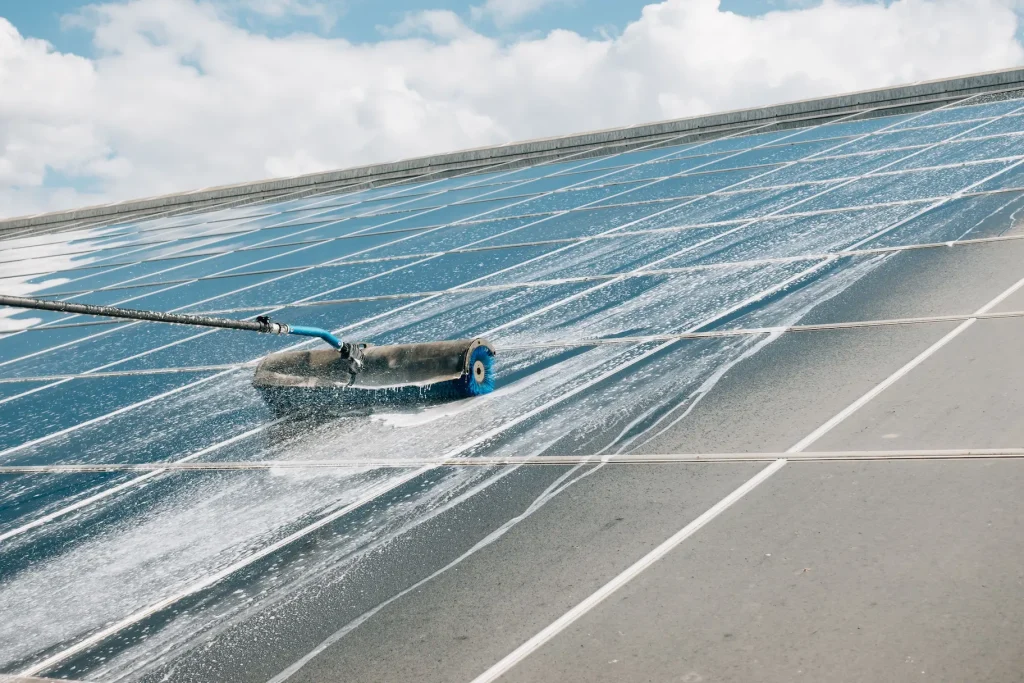
Professional solar panel cleaning is the planned removal of dust, dirt, bird droppings, and other deposits from a solar array, carried out by trained people with safe roof access and suitable equipment. For a commercial roof, a properly run job typically includes:
- A pre-work assessment of roof access, fragile areas, edges, and the layout of the array
- A height-safety plan before anyone goes on the roof
- Inspection of panels for cracks, damage, or heavy build-up before and after cleaning
- A cleaning method consistent with the panel manufacturer’s guidance
- Safe equipment handling, since tools dropped from a roof are a hazard to people below
- Records of what was done and when, ideally compared against output data
Supplier guidance is consistent on one point: panels should not be walked on, because that can damage them (Kränzle).
Why Solar Panel Cleaning Frequency Matters for South African Businesses
1. Legal and Regulatory Compliance
Cleaning a rooftop array is work at height, and the risk sits with the employer or the facility owner as much as with the contractor. A documented fall protection plan, trained personnel, and a clear record of who was on the roof and under what controls are what an inspector, insurer, or auditor expects to see.
2. Energy Output: What the Evidence Says
The figures vary enormously, and it is worth knowing where each one comes from.
- A solar panel cleaning supplier says dirty panels can lose up to 30% of their generating capacity (Kränzle).
- A sponsored article by a solar cleaning company, citing a 2022 review, puts losses at 15% to 70% depending on site conditions (Daily Maverick).
- An independent master’s study at the Kalkbult solar park in the Northern Cape measured much lower losses. At the winter peak, soiling losses were about 1% for untreated silicon modules and up to 4% for thin-film modules, losses were significant only from May to July, and heavy rain restored silicon module performance (Norwegian University of Life Sciences, 2016).
Neither side is necessarily wrong. The Kalkbult study covers one arid site over one winter, and cleaning needs differ for a coastal Cape Town roof, a warehouse beside a busy road, or a food plant. What the spread shows is that a fixed calendar is a poor substitute for measurement.
How Often Should Solar Panels Be Cleaned in South Africa?
Supplier guidance ranges from at least twice a year (Kränzle) to between one and four times a year depending on the type and level of soiling (Daily Maverick, sponsored). Both suggest inspecting panels around the start and end of summer, and cleaning more often where dust is heavy. The higher-soiling environments named include construction areas, cement factories, factories with boilers, and food plants that produce high-sugar products. In practice, the sound approach is to:
- Inspect on a schedule
- Compare actual output against expected output
- Clean when the data or the inspection says it is worth it
3. Asset Protection and Reputation
Heavy build-up can cause hotspots, which can overheat and damage cells. The wrong approach to cleaning can also damage panels, and walking on them is a clear example. Before any cleaning programme starts, it is worth checking the installer’s and manufacturer’s cleaning guidance and any warranty terms.
4. Risk Mitigation on the Roof
Falls from height are the biggest cause of fatalities in South Africa’s working-at-height industry (Engineering News). Roofs with solar arrays add edges, fragile areas, and equipment to the mix. Planning the access, the controls, and the rescue arrangements before the first visit is what separates a routine clean from an incident.
Why Outsource Solar Panel Cleaning?
Businesses often try to handle cleaning with whoever and whatever is already on site. That commonly results in:
- Roof work with no documented risk assessment or fall protection plan
- Untrained staff exposed to fall risk
- Panels damaged by walking on them or by the wrong equipment
- Cleaning done on a guess rather than against output data
- No record to show an insurer, installer, or auditor
A specialist contractor brings trained people, planned access, suitable equipment, and records, so the risk and the paperwork sit with a provider equipped to manage them.
Industries That Benefit From Regular Solar Panel Cleaning
Warehousing and Distribution Large roof areas carry big arrays, and roof access is the main safety issue.
Manufacturing and Food Production Industrial dust, boiler emissions, and sugar-heavy processes are among the higher-soiling environments named in supplier guidance.
Retail Centres and Corporate Offices Rooftop arrays supporting day-to-day operations make output losses visible on the electricity bill.
Schools and Healthcare Facilities Public buildings with occupants below need careful access planning and low disruption.
Agricultural and Packhouse Sites Supplier guidance notes that more frequent cleaning may be needed in agricultural and industrial areas where dust is common.
The Haztech Approach to Solar Panel Cleaning
Haztech cleans solar panels for commercial and industrial properties, applying the same compliance-first approach as the rest of its working at height services:
- Pre-work assessment of roof access and height risk
- Work planned around height-safety requirements, not around convenience
- SAQP and ISO certifications behind our service delivery
- Documented service records to support OHS, insurance, and audit requirements
- Integration with commercial cleaning and other facility services under one accountable provider
Call to Action
Do you know what your panels are actually producing compared with what they should be?
Partner with Haztech for commercial solar panel cleaning in Cape Town that is planned, documented, and carried out with the roof, and the people on it, in mind.
📞 Call Haztech Cape Town today at (021) 569 3770 or email info@haztech.co.za to schedule a solar panel cleaning assessment.
Reliable. Compliant. Always ready.
Frequently Asked Questions
How often should solar panels be cleaned in South Africa? Supplier guidance ranges from at least twice a year to between one and four times a year, depending on the type and level of soiling. Sites that are dusty, industrial, or agricultural may need more. The most reliable approach is to inspect on a schedule and compare actual output against expected output.
How much energy do dirty solar panels lose? Estimates vary widely. Suppliers cite losses of up to 30%, and a sponsored article citing a 2022 review gives a range of 15% to 70%. An independent study at a Northern Cape solar park measured peak winter soiling losses of roughly 1% to 4%. Your own output data is the best guide for your site.
Does rain clean solar panels well enough? Sometimes, but not reliably. The Kalkbult study found that heavy rain fully restored silicon module performance, while cleaning suppliers advise that rain alone is not enough to keep panels clean. Monitoring your output will show whether rain is doing the job on your roof.
Is it safe to clean rooftop solar panels myself? It carries real risk. Roof work exposes people to falls from height, and walking on panels can damage them. Supplier guidance advises safe access, a safe distance from roof edges, fall protection such as harnesses, secured equipment, and professional cleaners rather than do-it-yourself roof work.
What should I ask a solar panel cleaning contractor before they go on my roof? Ask for their risk assessment and fall protection plan, confirmation that their people are trained and fit for work at height, their records of equipment inspection, and how their cleaning method fits the panel manufacturer’s guidance. Ask how they will document the work.
Final Summary
The question of how often solar panels should be cleaned in South Africa has no single answer. Suppliers, reviews, and field studies report very different losses, which is why inspection and output data matter more than a fixed schedule. What does not change is that every cleaning visit is work at height, with legal duties, real fall risk, and panels that can be damaged by the wrong approach.
Haztech provides commercial solar panel cleaning in Cape Town, planned around height safety and documented for compliance.
To arrange a solar panel cleaning assessment, contact Haztech today.